

 Video call
 Talk to expert


 en
en



 Facebook
 Linkedin
 X (Twitter)
 Reddit
 Mail
Mail
 Copy Link


Following our introduction to diamond fluorescence, we’ve received numerous questions about this fascinating phenomenon. This comprehensive guide explores the science, effects, and value implications of fluorescence in natural diamonds and gemstones.
What Is Fluorescence and Where Does It Come From?
Fluorescence happens when a material absorbs invisible ultraviolet (UV) light and immediately releases it as visible light, creating a distinct glow. The term comes from scientist Sir George Stokes, who observed this effect in the mineral fluorite in 1852. In gemstones, this phenomenon results from specific impurities or irregularities within the crystal structure.

The Science Behind the Glow
In white diamonds, fluorescence typically occurs when trace amounts of nitrogen replace carbon atoms in the crystal lattice. These nitrogen atoms create defects that emit blue light under UV exposure. Boron impurities, found in rare blue diamonds, can cause different fluorescence colors including yellow, orange, or even red.
The process is simple: when UV light hits these defect centers, the energy is released as longer-wavelength visible light. This creates the characteristic glow that defines fluorescence.
How Common Is Fluorescence?
Not all gemstones fluoresce. In natural diamonds, approximately 25-35% show some degree of fluorescence when examined with a standard UV lamp. Among fluorescent diamonds, the vast majority (about 95%) glow blue under UV light because nitrogen-related defects typically emit blue wavelengths. Rarely, diamonds can fluoresce other colors like yellow, orange, white, or green when different trace elements are present.
Interestingly, diamonds with high concentrations of certain impurities sometimes show no fluorescence at all. The impurities can actually suppress the effect rather than enhance it.
Fluorescence in Other Gemstones
Beyond diamonds, many gemstones owe their fluorescence to different trace elements:
Rubies (red corundum) famously fluoresce vivid red under UV light due to chromium. Fine Burmese rubies with high chromium content exhibit a strong red fluorescence that makes them appear even more brilliant in sunlight. Rubies from other locations often contain more iron, which dampens their fluorescence.
Emeralds (green beryl) can show a faint red fluorescence if chromium is present, though iron typically suppresses it. Some Colombian emeralds may display a subtle red glow, but it’s generally much weaker than ruby.
Other gemstones have unique fluorescent behaviors. Some spinel fluoresces bright pink, certain sapphires fluoresce orange or red when they contain chromium, and various other gems display their own characteristic patterns. For gemologists, fluorescence serves as a valuable diagnostic tool to distinguish natural gems from synthetics and to infer geographic origin.
How Is Gemstone Fluorescence Detected and Graded?
The Detection Process
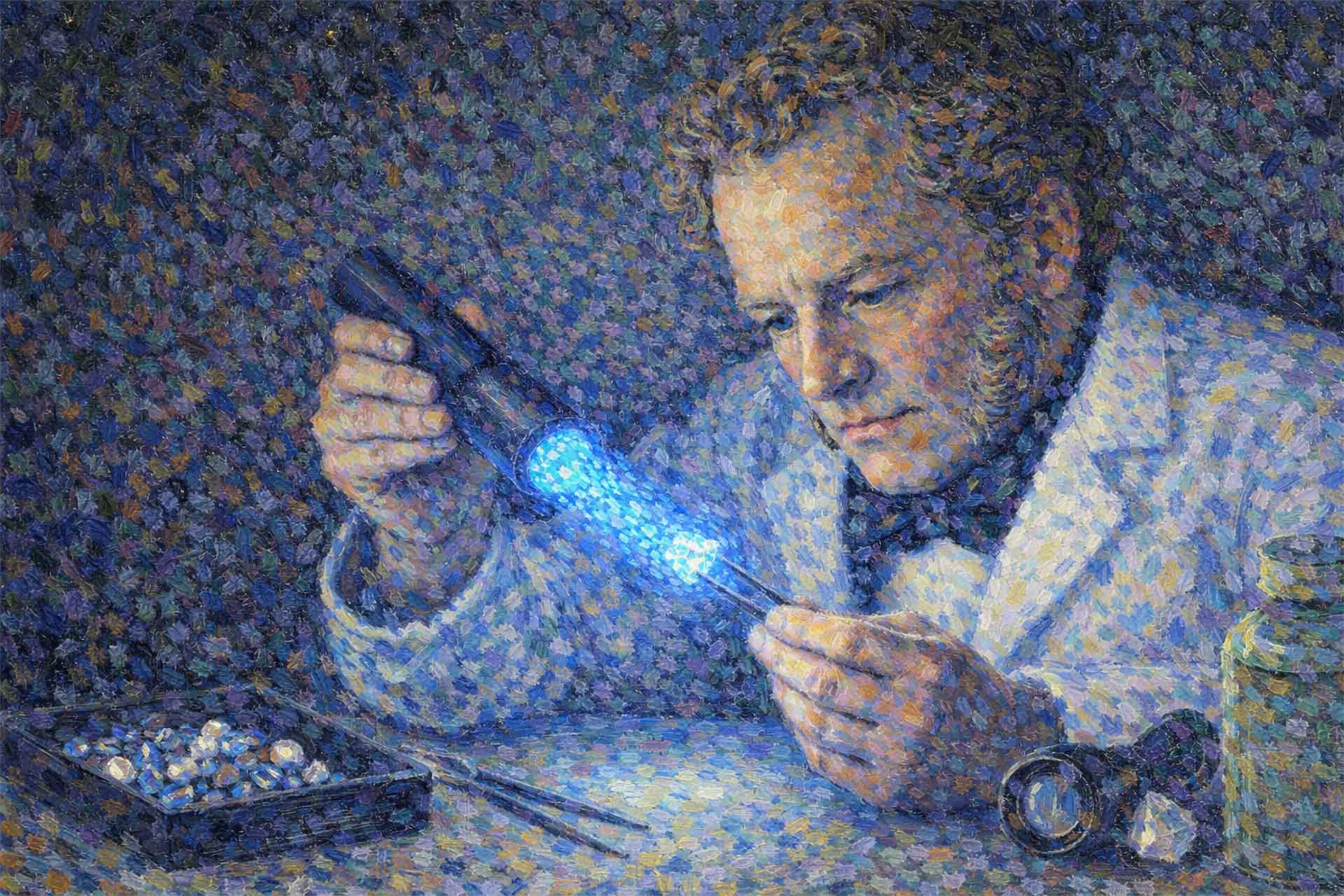
Gemologists test fluorescence by exposing stones to ultraviolet light, typically using a long-wave UV lamp (around 365 nanometers) in a darkened environment. They observe whether the gem emits visible light, noting both the color and intensity of any glow. This is similar to the effect you might see when a diamond glows under a blacklight in a club or in strong sunlight.
Laboratories use controlled UV sources to ensure consistency. Reputable grading labs follow strict protocols: the diamond is placed in a dark box, illuminated with UV light, and trained graders observe the strength of fluorescence by comparing it to predefined standards.
Understanding the Grading Scale
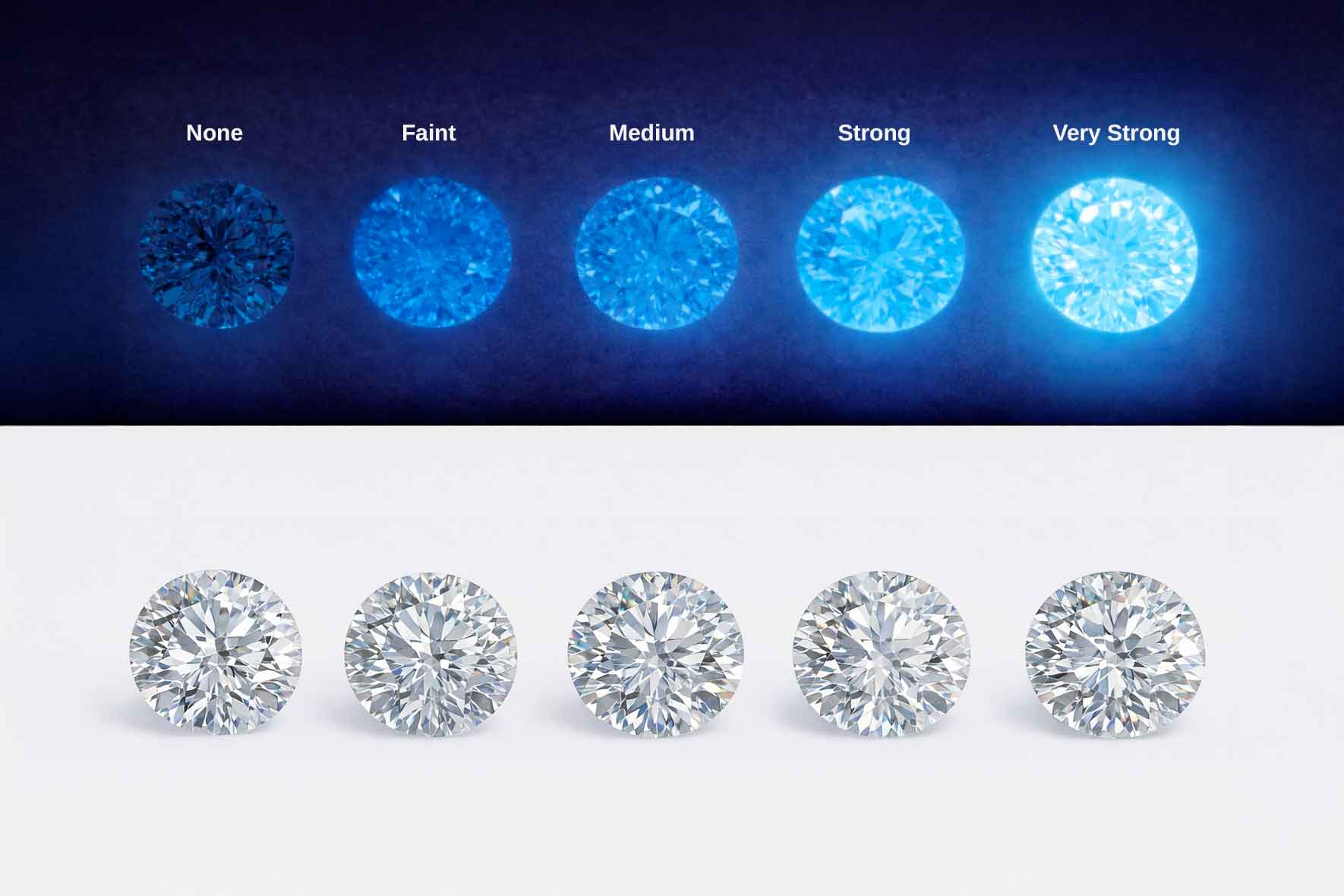
While fluorescence isn’t graded like the traditional factors of carat weight, color, clarity, and cut, laboratories do classify its intensity. The Gemological Institute of America (GIA) and other major labs report fluorescence in these qualitative levels:
- None – No visible fluorescence
- Faint – Barely detectable glow
- Medium – Noticeable fluorescence
- Strong – Significant glow
- Very Strong – Intense, obvious fluorescence
When fluorescence reaches Medium intensity or stronger, labs also note the color of the fluorescence on the report. For example, a GIA report might state “Fluorescence: Strong Blue” or “Medium Yellow” if applicable. In most cases, you’ll see “None,” “Faint,” or “Medium Blue,” with blue being the default assumption unless otherwise stated.
Global Laboratory Standards
All major gemological laboratories test and report fluorescence. Whether you receive a grading report from GIA (USA), AGS (American Gem Society), HRD (Antwerp), IGI (International Gemological Institute), or other respected labs, the certificate will include a fluorescence description. Testing methods and terminology are largely consistent worldwide, with most following the five-level convention established by GIA.
During grading, the gem is observed for fluorescence in a controlled lab setting separate from the display lighting used for color grading. This ensures that fluorescence doesn’t influence the diamond’s color grade. The fluorescence grade is recorded as an identifying characteristic of the stone rather than a quality grade.
When and How Is Fluorescence Visible?
The Right Lighting Conditions
Fluorescence is only visible when the gem is under UV-rich lighting. Under normal indoor lighting like incandescent bulbs or most LEDs, a fluorescent diamond won’t visibly glow because these lights contain little to no UV wavelengths.
Certain environments provide enough UV to trigger fluorescence:
- Direct sunlight (which contains UV components)
- Tanning beds
- Blacklight lamps
- Some high-intensity fluorescent lights
In sunlight, a strongly fluorescent diamond might show a subtle bluish tint or inner glow. Under a concentrated UV lamp in a dark room, the effect becomes very obvious with bright blue coloration. The fluorescence stops immediately when the UV source is removed—it’s an instantaneous reaction, not a lingering light.
What You’ll Actually See
You cannot see diamond fluorescence in all lighting conditions. A diamond won’t fluoresce under purely incandescent light. This is why a diamond can appear perfectly normal under jewelry store lights or indoor home lighting, yet surprise someone by glowing in a dance club with UV lamps. Many owners of fluorescent diamonds never notice any difference in everyday wear unless they specifically check under UV.
When fluorescence is visible, it typically appears as a blue glow emanating from the entire stone. The diamond doesn’t change color, but the blue emission overlays its body color. In rare cases where fluorescence is another color, the glow could be yellowish, green, orange, or even white. The fluorescence is usually evenly distributed, though some diamonds might show zoned or mottled patterns under UV due to growth variations in the crystal.
The Reality of Everyday Appearance
Most importantly, fluorescence is generally subtle under normal viewing conditions. Extensive research has found that for the vast majority of diamonds, even those with Medium to Strong fluorescence, observers in typical lighting cannot reliably see any difference in transparency or color compared to non-fluorescent diamonds. In many cases, people cannot tell whether a diamond fluoresces without using a UV lamp.
Under typical indoor conditions, a fluorescent diamond looks virtually identical to a non-fluorescent diamond of the same quality.
The Rare Exception: Overblue
There is one important caveat. In extremely rare instances, very strongly fluorescent diamonds can exhibit a phenomenon called “overblue” or a hazy, oily appearance. This occurs when fluorescence is so intense that under bright UV-rich light, the stone’s brilliance appears slightly milky. However, fewer than 0.2% of fluorescent diamonds show any haziness due to strong fluorescence.
While nearly one-third of diamonds fluoresce, only a tiny fraction have any negative visual effects. The fluorescence itself doesn’t damage or alter the gem’s integrity—it’s simply light. If a diamond appears hazy, it’s usually due to other factors like microscopic inclusions or crystal structure issues, and strong fluorescence can make inherent haziness more noticeable rather than causing it.
Does Fluorescence Affect Appearance and Color?
The Color Enhancement Effect
One of the most interesting aspects of fluorescence is its interaction with a diamond’s color appearance. Because blue is the complementary color to yellow, a blue fluorescent diamond can look whiter or less yellow when exposed to UV-rich light.
For diamonds in lower color ranges (I, J, K down to M) that have a noticeable yellow tint, moderate to strong blue fluorescence can act like nature’s whitener. The blue glow cancels some of the yellow, giving the diamond a higher apparent color grade in UV-rich lighting. In practical terms, an I-colored diamond with medium blue fluorescence might appear closer to an H color in daylight, looking more colorless than its laboratory grade suggests.
This effect has been noted by traders for decades and is one reason fluorescent diamonds were historically called “blue-white diamonds.” The blue glow imparted a snowy whiteness to off-color stones.
Impact on Different Color Grades
Fluorescence doesn’t change the diamond’s fundamental color grade as determined in the lab, since color grading is done under UV-filtered light. However, it can change perceived color in certain environments.
Studies confirm that observers sometimes prefer the appearance of diamonds with medium or strong fluorescence, especially in lower color grades, because they look slightly more colorless. Even in colorless diamonds (D-F color) viewed face-up, some strongly fluorescent stones were perceived to have better color, appearing ultra-white or bright without any noticeable downside.
In the highest color grades (D, E, F), there’s no yellow tint to neutralize, so strong blue fluorescence doesn’t provide a whitening benefit. These colorless diamonds are sometimes preferred without fluorescence to maintain their pure, icy appearance. If a D-color diamond has very strong blue fluorescence, there’s a slight risk that in some lighting it could exhibit a faint bluish haze—the previously mentioned “milky D” scenario. However, if the diamond is well-cut with good crystal structure, even strong fluorescence usually doesn’t detract from its brilliance or transparency.
Beyond Diamonds: Ruby’s Red Glow
In gemstones beyond diamonds, fluorescence can also enhance apparent color. A classic example is ruby: the strong red fluorescence of a Burmese ruby under sunlight makes the stone look even redder and more vivid, effectively boosting its color intensity. This is considered a positive effect and one reason Burmese rubies are so prized compared to Thai rubies, which have weaker fluorescence and often appear duller in daylight.
Whether fluorescence is “good” or “bad” for appearance depends on the gem and context. In rubies, it’s usually beneficial. In diamonds, it can be neutral or advantageous in many cases, and only potentially problematic in rare circumstances of extreme fluorescence combined with high color grades.

Impact on Value: Is Fluorescence Good or Bad in the Market?
Understanding Market Perceptions
The effect of fluorescence on a diamond’s market value has been debated for decades. The answer depends on the intensity of fluorescence, the color grade of the diamond, and evolving market fashions.
Price Impact by Color Grade
Here’s how fluorescence typically affects diamond pricing in today’s global trade:
Colorless Diamonds (D-F):
- None/Faint: No price impact (premium for top stones)
- Medium: Slight discount (0-5%)
- Strong/Very Strong: Moderate discount (5-15%)
Near-Colorless (G-J):
- None: Standard market price
- Faint/Medium: Minimal to no discount (sometimes slight premium)
- Strong: Slight discount or neutral (depends on actual appearance)
Faint Yellow (K-M):
- Medium/Strong: Often neutral or slight premium (due to whitening effect)
- Very Strong: Neutral to slight discount (check for overblue)
Why the Price Differences?
Historically, strongly fluorescent diamonds have sometimes been undervalued. In the current market, strong or very strong blue fluorescence in a high-color (D-F) diamond is usually seen as a negative by buyers, leading to price discounts. Many shoppers have heard that “fluorescence is bad” in a colorless diamond, largely due to fear of the hazy “overblue” effect (even though it’s rare). If you’re paying premium prices for a D color diamond, you may not want any unusual characteristics in UV light.
Conversely, fluorescence can be a selling point for lower color diamonds. A well-cut J or K with nice medium blue fluorescence is sometimes marketed as “facing up like an I or H” thanks to its fluorescence. Some buyers specifically seek these as a value option—essentially getting a diamond that looks whiter in sunlight for a lower price. These can command slight premiums in markets where that advantage is appreciated.
The Evolution of Market Attitudes
Market perceptions of fluorescence have evolved significantly over time. In the early 20th century, strong blue fluorescence in near-colorless diamonds was actually marketed as a positive attribute, and such stones sold at a premium. Later, attitudes reversed.
Today, many gem professionals believe the blanket stigma against fluorescence is outdated. Major laboratories have published research debunking myths that fluorescence always hurts a diamond’s appearance or value. For most diamonds, fluorescence has no negative effect and cannot even be detected without specialized lighting.
The Bottom Line on Value
When buying or selling a diamond, fluorescence is one factor to consider. It’s neither universally good nor bad. A prudent approach is to judge each individual stone in various lighting conditions. Many strongly fluorescent diamonds are absolutely beautiful and present an opportunity to get a discount on a stone that looks great.
If you have a perfectly colorless D/IF stone with strong fluorescence, be aware some buyers will expect a discount due to market perception. From a neutral standpoint, fluorescence should be just a characteristic, not a defect. Overall, diamond fluorescence should not be a major factor in purchasing decisions—its effects are negligible and often slightly positive in most cases.
Historical Perspective: From “Blue-White” Hype to Modern Understanding
The “Blue-White” Era
Fluorescence in diamonds has an intriguing history in the gem trade. In the late 19th and early 20th century, jewelers observed that some diamonds in sunlight showed special brilliance—a “bluish white” glow. These diamonds, often from South African mines like Premier and Jagerfontein, had strong blue fluorescence and appeared exceptionally white and bright under daylight.
They became known as “blue-white” diamonds, a term describing high-color diamonds with distinct blue fluorescence. At that time, “blue-white” was a mark of desirability, and such stones commanded premium prices. Dealers actively sought strongly fluorescent stones for their perceived extra sparkle.
The Turning Point
However, misuse of the term began to occur. Some traders applied “blue-white” misleadingly to off-color diamonds that merely had fluorescence, implying they were top-quality colorless stones. This led to confusion and deceptive marketing practices.
In 1938, the U.S. Federal Trade Commission banned the term “blue-white” for diamonds, deeming it deceptive to consumers. From that point forward, sellers could no longer advertise diamonds as blue-white. The banning of this terminology removed the open promotion of fluorescence as a selling point and marked a significant turning point in how the industry discussed this phenomenon.
The “Milky D” Stigma
Moving into the mid-20th century, perceptions shifted negatively. In the 1970s, during a diamond market boom, some dealers noticed that a few D-color diamonds with very strong blue fluorescence looked milky or oily. These were dubbed “milky Ds”—theoretically top color diamonds that weren’t as transparent as expected, possibly due to their fluorescence or underlying crystal graining.
Word spread within the trade, and stigma grew around fluorescent diamonds. Not only were strongly fluorescent D colors discounted, but eventually even lower colors and faint fluorescence started to be viewed with suspicion by some buyers, despite lack of evidence that faint fluorescence affected appearance at all.
The 1990s Market Shift
The issue was compounded in the early 1990s by several events. First, a scandal involving some laboratories in South Korea over-grading the color of fluorescent diamonds came to light. These labs had given fluorescent diamonds higher color grades than deserved, not properly accounting for fluorescence during grading.
When this became known, many consumers realized their “E color” diamonds might really appear like F or G without the fluorescence, leading to loss of confidence. Buyers reacted by avoiding fluorescent stones, a sentiment that influenced Asian markets broadly. Around the same time, certain mines produced a surge of fluorescent diamonds, increasing supply. The combination of oversupply and nervous consumers meant fluorescent diamonds, especially strong blue ones, became notably cheaper than non-fluorescent diamonds in the 1990s.
Scientific Validation
This negative view persisted into the 2000s, even as scientific evidence mounted that fluorescence isn’t actually a problem for most diamonds. In 1997, a comprehensive study concluded that observers could not consistently tell the difference between diamonds with no fluorescence and those with various degrees of fluorescence when examining them in typical lighting conditions. Many actually preferred the look of strongly fluorescent diamonds without knowing it.
The study reaffirmed that only in extremely rare cases did strong fluorescence cause haziness, and those stones were outliers. Despite this, the market was slow to release old prejudices. Pricing guides traditionally applied discounts for fluorescence in high colors, reflecting continuing caution.
The Modern Renaissance
Today, there’s a renaissance in thinking about fluorescent diamonds. Some industry voices are calling it a “new value proposition.” One reason is the emergence of lab-grown diamonds in the market. Lab-grown diamonds often have different fluorescence behavior—many don’t fluoresce blue like natural diamonds, or they fluoresce under different UV wavelengths.
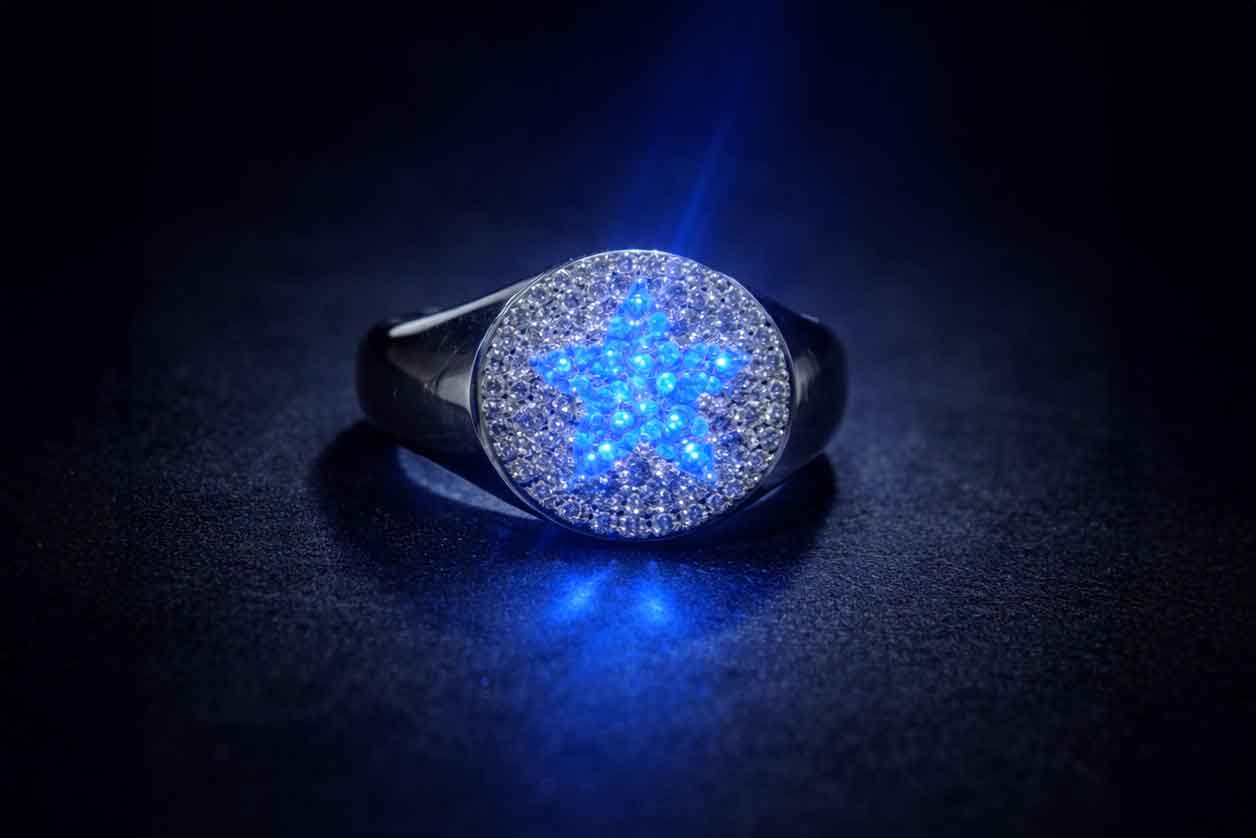
As consumers become aware of natural versus lab-grown differences, the presence of classic blue fluorescence is being marketed as a sign of a natural diamond’s uniqueness. Natural fluorescing diamonds are being positioned as something special that lab-grown stones typically lack.
Retailers have started telling the story of fluorescence positively again: it’s a “marvel of nature” that makes a diamond one-of-a-kind and can even enhance beauty, rather than something to hide. Jewelry designers have also gotten creative, creating pieces that deliberately use fluorescent diamonds for surprise effects—hidden patterns that only appear under UV light.
How Important Is Fluorescence as a Factor?
Fluorescence in Context
Given all the information above, you might wonder: Should I care about fluorescence when evaluating a diamond or gem? The answer: it’s a secondary factor, but one that can be relevant to aesthetics and value in certain cases.
Fluorescence is not part of the famous “4Cs” of diamond quality. It’s an identifying characteristic rather than a quality grade. This means in the hierarchy of factors like color, clarity, cut, and carat weight, fluorescence usually comes after those in importance. A well-cut diamond with excellent color and clarity will be beautiful whether or not it fluoresces.
When Fluorescence Matters
However, fluorescence can be an important distinguishing factor. It sets two otherwise similar diamonds apart. Some people deliberately seek fluorescence (for example, a strong blue fluorescent D color at a bargain price, or a medium fluorescent J color that looks nicer than a non-fluorescent J). Others deliberately avoid it, perhaps out of caution or because they mostly view diamonds under UV-free lighting where it offers no benefit.
In the gem trade, dealers pay attention to fluorescence especially when dealing with top-color diamonds or matching stones. For instance, when crafting a pair of earrings, one wouldn’t pair a strongly fluorescent diamond with a non-fluorescent diamond, because under UV one earring would glow and the other wouldn’t. They’d either match fluorescence or pick stones without it for uniformity.
Market Expectations
In high-end colorless diamonds (D-F, IF clarity aimed at very discerning clientele), sellers often prefer “None” or “Faint” fluorescence stones simply because that’s the market expectation for the very best stones. When it comes to slightly tinted diamonds (G color and below), many traders are neutral or even positive about fluorescence, recognizing it can enhance appearance.
Education is key: once buyers understand what fluorescence really is, they often become more open to it and may even appreciate the unique “secret glow” their gem possesses.
For Colored Gemstones
In colored gemstones, fluorescence can be quite important for identification and origin analysis. Gem laboratories consider fluorescence reactions under both long-wave and short-wave UV when determining if a stone is natural or synthetic.
For example, some synthetic rubies fluoresce orangey or have an overly strong, uniform fluorescence that differs from natural rubies. Certain natural origins can be hinted by fluorescence: a natural ruby from Myanmar typically has strong red fluorescence, whereas a Thai ruby (with more iron) has weak fluorescence. Gemologists use this clue alongside other tests to determine origin.
In emeralds, synthetic stones often show a dull red or orange fluorescence, whereas a natural Colombian emerald might show very faint red or no reaction due to iron content. Thus, fluorescence is an important factor in laboratories for what it reveals about a gem’s authenticity and origin, even if end consumers might not visibly notice it.
Who Tests for Fluorescence?
Laboratory Standards Worldwide
Virtually all professional gemological laboratories test for and report fluorescence as part of their standard procedures for diamonds and often for colored gems as well. The Gemological Institute of America (GIA), the world’s largest diamond grading lab, includes a fluorescence line on every Diamond Grading Report using their 5-level scale.
The American Gem Society (AGS) Laboratory also reports fluorescence using the same basic terminology. European labs like HRD Antwerp, Gübelin, and SSEF document fluorescence reactions in their reports and research. The International Gemological Institute (IGI), which operates globally, likewise lists fluorescence on diamond reports. In Asia, labs such as GIA’s Hong Kong or Tokyo laboratories, China’s NGTC, and others all examine fluorescence for graded stones.
It’s a global standard practice—any complete lab report on a diamond should indicate if and how that diamond fluoresces.
Testing Procedures
Laboratories maintain consistent conditions for fluorescence testing: a controlled UV light source, typically long-wave UV, in a dark environment. Grading staff is trained to categorize intensity by comparing the stone’s glow to master stones or reference images, ensuring that “Medium” means roughly the same strength in New York as it does in Antwerp or Mumbai.
Labs adhere to set standards in describing intensity to ensure objective and consistent reporting. This means a buyer can trust that a Strong fluorescence grade from any top lab indicates a notably strong reaction.
Beyond Professional Labs
Beyond laboratories, many jewelers and appraisers have handheld UV lamps for quick fluorescence checks. It’s one of the simpler gemological tests—even a small portable blacklight can reveal if a diamond glows. This simplicity is why fluorescence was noticed early in gemology’s history and why it remains a useful field test.
Testing for fluorescence is a routine part of gemological analysis. All major labs test it to maintain complete information on gemstones. If you have a diamond report from any reputable lab, you’ll find the fluorescence notation there, ensuring transparency about this characteristic.
Fluorescence in Other Gemstones: Beyond Diamonds
Ruby and Sapphire (Corundum)
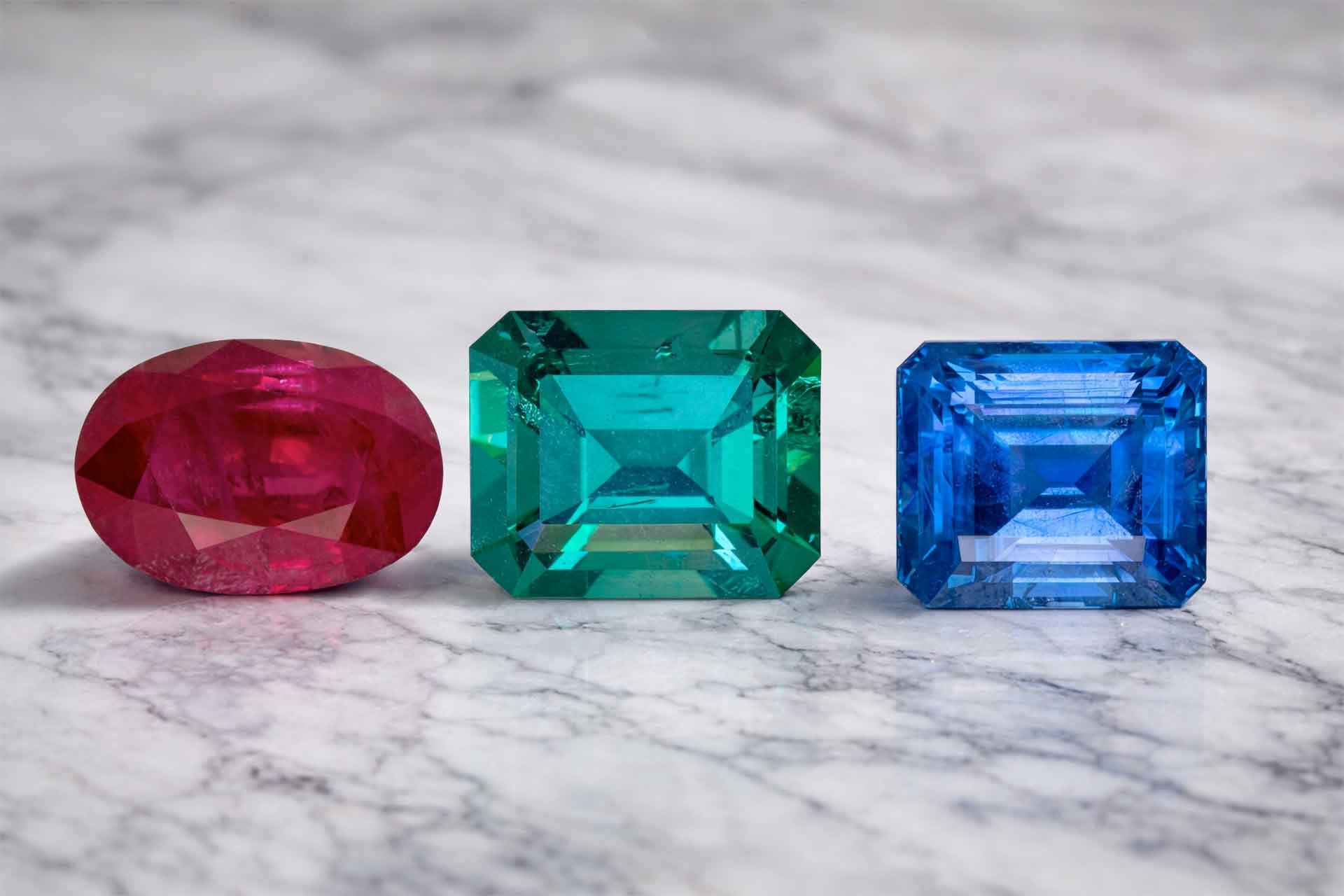
Ruby’s red fluorescence due to chromium is a well-known phenomenon. It contributes to the famed brilliance of fine Burmese rubies, enhancing their red glow in sunlight. Sapphire, the same mineral in different colors, can also fluoresce if it contains chromium. Some pink sapphires or padparadscha sapphires show orange or pink fluorescence.
However, blue sapphires typically don’t fluoresce because the trace elements causing blue color (iron and titanium) actually suppress fluorescence. In gemology, ruby’s fluorescence helps distinguish a Burmese ruby (strong fluorescence) from a Thai ruby (weak to none, due to higher iron). Synthetic rubies, especially flame-fusion types, often show intense orangey-red fluorescence that’s too strong or slightly different from natural ruby—providing a detection tool.
Emerald (Beryl)
Natural emeralds, especially from Colombia, sometimes exhibit very weak red fluorescence (again due to chromium), but many are inert because even trace amounts of iron suppress fluorescence. Interestingly, some synthetic emeralds (particularly flux-grown) have stronger red fluorescence because of their chemistry, and this difference is used as an identification clue.
A synthetic emerald might glow bright red under long-wave UV, whereas a natural Colombian emerald of high quality might show only a dim red or no reaction. This “fluorescence test” for emeralds isn’t definitive alone, but it’s part of a suite of tests gemologists use.
Fancy Color Diamonds
Not only colorless diamonds fluoresce—fancy color diamonds can too. Some fancy yellow diamonds fluoresce yellow or green; many pink diamonds from certain mines fluoresce orangey or red due to nitrogen-vacancy centers. The famous Hope Diamond, a deep blue diamond, fluoresces surprising red and even phosphoresces red-orange for several seconds after UV exposure.
While fluorescence in color diamonds can be intriguing, it’s generally just a curious property. No significant price impact is typically assigned to fluorescence in fancy color diamonds, except that strong undesired fluorescence might slightly affect how the face-up color is perceived.
Collector Gemstones and Minerals
Many collector gemstones and minerals fluoresce in brilliant colors under UV. Fluorite can fluoresce blue (the namesake mineral). Calcite can glow red, pink, or green depending on impurities. Kunzite often fluoresces pink to orange. Opal sometimes fluoresces green or white. Spinel can fluoresce bright red, especially hot pink/red spinels from certain locations due to chromium.
From a practical standpoint, gem labs and appraisers use these fluorescence reactions to help identify unknown gems. For example, a gem that looks like a ruby but has absolutely no fluorescence might be a garnet or red spinel instead, since many natural rubies fluoresce at least to some degree.
Value and Appeal in Colored Gems
In gem trading, fluorescence in colored gems doesn’t usually detract from value; often it’s neutral or even positive. An exception might be if fluorescence is so strong it causes a color change under certain lights. But generally, it’s viewed as a charming characteristic. Many gem enthusiasts actually enjoy collecting fluorescent gems for the extra “light show” they provide under UV lamps.
Conclusion: Understanding Fluorescence as Nature’s Light Show
Fluorescence in natural diamonds and gemstones represents a fascinating intersection of science and beauty. It originates from the tiniest impurities—a few atoms of boron, a chromium ion—yet can have visible, sometimes stunning effects. Fluorescence can make a diamond appear whiter, a ruby seem more vivid, or reveal secret patterns in jewelry under UV light.
Understanding fluorescence adds depth to traditional evaluation factors by introducing what some call a “5th characteristic” that’s all about light and optics. It reminds us that gems aren’t static objects; they interact dynamically with their environment. A diamond that’s calm and quiet indoors might come alive with a blue glow in UV lighting—and that’s genuinely magical.
Practical Guidance
From a practical standpoint, if you’re considering a fluorescent diamond, remember the expert consensus: in most cases, it’s a non-issue for appearance, and it might even be a bonus. Ensure you see the stone under various lights if possible, and rely on trusted lab reports (which always note fluorescence) for full disclosure.
If you’re a jeweler or gemologist, appreciate how fluorescence can be both a tool for identification and a story for sales—an often overlooked but intriguing selling point that differentiates one gem from the next. In an era where consumers crave uniqueness, fluorescence serves as nature’s signature.
Final Thoughts
Whether a gem fluoresces or not, and whether that’s viewed positively or negatively, comes down to knowledge and perspective. Armed with facts and historical context, we can appreciate fluorescence as neither curse nor cure-all, but as one more facet of nature’s gemological wonders.
For those interested in learning more about diamond formation and characteristics, explore our guides on how diamonds are formed and understanding white diamonds. These resources, along with our comprehensive education center, provide the knowledge you need to make informed decisions about diamonds and gemstones.
In the end, fluorescence is one more fascinating characteristic that makes each natural gemstone unique. Understanding it transforms a puzzling oddity into an appreciated feature of Mother Nature’s artistry—a certain glow that adds character and story to the world’s most beautiful natural treasures.





 Back
Back